CaliPills Website Logo

Need Help? Call Us:
+1 866 322 5001

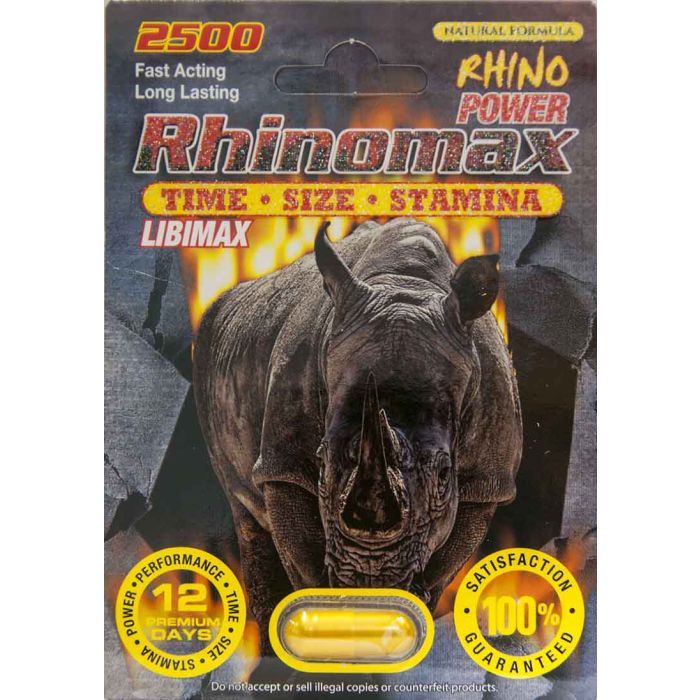
Rhinomax Rhino Power by Libimax is a men's herbal dietary supplement supplied as one 2500 mg capsule sealed on a single blister card. The capsule itself is gold and sits in a clear bubble at the base of the card, below the rhino artwork. The card is printed in English on both faces, carries a full Supplement Facts panel on the reverse, and is distributed by Exiom Health Science and made in the USA.
The format matters as much as the formula here. This is a hang-tab card roughly the size of a postcard, not a bottle: one sealed capsule, no cap, no cotton, no scoop and nothing to measure. It sits in the herbal single-serve category rather than the daily-multivitamin category, which is why it is stocked alongside the rest of the Rhinomax range and the wider Rhino Products shelf rather than with the tubs and jars.
The panel declares one proprietary blend rather than individually weighted ingredients, so the manufacturer publishes the plant list but no milligram figure for any single entry. That is normal for this style of multi-herb formula, and it means nobody — including us — can tell you how much of any one botanical is present. Here is what the blend list actually names, with a little background on the better-known entries.
For general grounding on how botanical supplements are made and regulated, the NIH Office of Dietary Supplements publishes a plain-English introduction to botanical dietary supplements. Those pages describe ingredient categories in general terms and say nothing whatever about this product.
| Panel line | As printed on the card |
|---|---|
| Serving Size | 1 Capsule 2500mg |
| Proprietary Raw Material | 1250 (no unit printed alongside the figure) |
| Proprietary Blend | Superoxide Dismutase, Proprietary Formula, Rubus, Panax Ginseng, Pueraria Lobata, Cordyceps Sinensis, Cornus, Dismutase, Cinnamon Bark, Dand Gui, Licorice, Cussula, Atractylodes, Deng Sen Extract, Condonopsis |
| % Daily Value | Daily Value not established |
Every line above is transcribed from the printed panel rather than from a supplier sheet or a catalogue record. Where the card prints a figure without a unit we have left it exactly as printed instead of supplying one, and where a spelling is unconventional we have kept the card's version.
The card gives one hard limit: do not use more than one capsule every 60 hours. That is the only frequency instruction printed anywhere on the packaging, and it is the figure to work from — 60 hours is two and a half days between servings, which is longer than most people assume when they skim it. The panel prints no time of day, no with-food or without-food instruction and no window before any activity, so none is offered here. Take it as directed on the card and do not exceed the suggested serving.
Storage is equally simple: keep the card in a cool, dry place, away from direct light and moisture, and leave the capsule in its sealed bubble until you intend to use it. The front of the card also asks buyers not to accept illegal copies or counterfeit product, so it is worth a look at the seal before opening.
This is for adults 18 and over who want a single herbal serving rather than a month's supply. A one-capsule card suits three people in particular: someone sampling the Libimax formula for the first time without committing to a jar, someone who prefers to keep one on hand rather than run a daily routine, and someone who already knows the range and simply wants one more card in the drawer. The trade-off is straightforward — the per-serving cost of a single card is higher than the same formula bought in a multi-count jar, and you are paying for the convenience of not buying twelve at once.
If you take a supplement every morning as part of a fixed routine, a single card is the wrong format for you; browse the broader supplements selection instead. It is not for anyone under 18, and it is not a food, a medicine, or a substitute for either.
The card prints a specific safety instruction that is worth repeating in full: consult a physician if you have heart problems. Stop using immediately if undesirable effects develop, and keep the product out of the reach of children. If you take prescription medication of any kind — nitrates in particular — speak to a licensed healthcare professional before using any herbal product in this category. The NIH Office of Dietary Supplements' guide to what you need to know about dietary supplements is a sensible starting point if that is unfamiliar ground.
The panel states that Daily Values are not established for the blend, which means there is no official reference intake to compare a serving against. That is a labelling fact rather than a criticism: most botanical ingredients have no established Daily Value because no reference intake has ever been set for them. No Proposition 65 warning is printed anywhere on this packaging, so none is reproduced here.
Shipping and packaging: your order ships in plain packaging with nothing on the outside indicating the contents, sent under a neutral business name. Product photographs are illustrative. Packaging, lot codes and printed dates vary between shipments.
One capsule, sealed on a single blister card. The capsule is gold, and the card is a hang-tab format a little smaller than a postcard, printed front and back.
The label states: do not use more than one capsule every 60 hours. That is the only frequency figure printed on the packaging, and it works out to two and a half days between servings rather than two.
No — the panel declares a single proprietary blend rather than a milligram amount per botanical. The serving is printed as 1 Capsule 2500mg, and the full blend list is transcribed in the table above exactly as the card gives it.
It is made in the USA and distributed by Exiom Health Science, both printed on the back of the card. The brand marks on the front are Rhinomax and Libimax, and the barcode on the reverse reads 4 94922 71522 5.
Yes. Orders ship in plain outer packaging with no product names, branding or imagery on the outside, and the sender shows as a neutral business name rather than the store.
These statements have not been evaluated by the Food and Drug Administration. This product is not intended to diagnose, treat, cure, or prevent any disease. Dietary supplement for adults 18 and over. Consult a licensed healthcare professional before use, especially if you have a medical condition, heart concerns, or take prescription medication (including nitrates). Keep out of reach of children.
| Boxed | No |
|---|---|
| Time Needed for Effectiveness | 60minutes |
| Serving Size | 2500mg |
| Quantity in Box/Display | 24 |
| Time effects last | up to 12 days |
| GTIN | 0494922715225 |
| UPC Value | 494922715225 |
| Product Type | Supplement |
| Item Form | Capsule |
| Pill Color | Gold |
Posted on
Posted on
Posted on
Posted on
Posted on
Posted on
Posted on
Posted on